

Battles of Lexington and Concord
April 19, 1775

Years of tension between the American colonists and British monarchy came to a head in the first battles of the Revolutionary War. On April 18, 1775, British troops marched from Boston to seize weapons that colonists had been stockpiling. The next morning, shots were fired at a standoff on the Lexington Green and open fighting broke out in Concord. British troops retreated to Boston. As they marched back, local Massachusetts militias attacked them.
Among the Massachusetts militias that responded—called Minute Men—were several men who moved to Livermore after the war. Elijah Livermore, the man Livermore is named after, was a Lieutenant in the Massachusetts Militia during the war.
Elijah Livermore was born in Waltham, Massachusetts, around 1730. His father was deacon of the Congregationalist Church in Waltham. Upon his father’s death, Livermore inherited his homestead and became deacon as his father had been. He came to the area that would become Livermore in 1771 on an exploration tour and returned in 1772 as part of the first survey committee dividing the land into lots. He remained in Livermore for the next two years, having chosen a lot where he planted corn and potatoes. In 1775, with the start of the Revolutionary War, Livermore left Maine and joined the war effort as a Lieutenant of the Massachusetts Militia. He served until 1779, when he moved his family to Maine. Livermore was the principal proprietor of the town, controlling the sale of lots by acquiring the original land titles. He was intentional in his selling of the land, careful to include men skilled in various occupations so as to ensure the town’s success. He held the first town office meeting in his house in 1795, and was the town’s first representative in the General Court of the Commonwealth. The town of Livermore was named after him. At the time of his death, Elijah Livermore was a wealthy man—he owned 1,120 acres of land, $10,000, and extensive livestock and personal property.
After the Battles of Lexington and Concord, the British retreated to Boston. The colonial forces soon began a siege of the city, which lasted until March of 1776. A Livermore settler named Ebenezer Learned led the first colonial force to re-enter the city after the siege ended and the British evacuated Boston.

Ebenezer Learned was born in Oxford, Massachusetts, in 1728, where he inherited 200 acres and had ten children with his first wife. In 1772, Learned served alongside Elijah Livermore and Richard Woodward as the initial survey committee of the land that would become Livermore. Despite serving as a proprietor, Learned never lived in Livermore, returning to Oxford and serving in the Massachusetts war effort. He was an active member of the local militia, and led a company to Boston two days after the Battle of Lexington and Concord. He was named a colonel and given a regiment known as Learned’s Regiment, which was adopted into the Continental Army. During the Siege of Boston, General Washington gave Learned command of the Dorchester Heights position, and Learned was in correspondence with Washington regarding the position. After the British evacuated Boston, Colonel Learned was the first to enter the city, leading a battalion of 500 men to secure the city. He was chosen specifically for this task because he was immune to smallpox—having contracted it in 1757—making him immune to the smallpox outbreak that Boston experienced in 1775. Learned resigned from the army in 1776 for health issues, but later returned to duty in 1777 and was named a brigadier general. During the Battle of Saratoga, his brigade got lost in the woods and missed the Battle of Freeman’s Farm. During the Battle of Bemis Heights, Benedict Arnold took command of Learned’s brigade without orders, leading them in an attack on British forces. Learned also commanded a brigade at Valley Forge. He resigned for good in 1778, both for health reasons and facing accusations of stealing supplies.

Learned returned to Oxford, where he died in 1801. His son, David Learned, settled in Livermore in 1790 as one of the first settlers, where he built a sawmill and became the first trader in town.
Crossing the Delaware River
December 25, 1776
In late 1776, the colonial forces were suffering from lack of troops and recent losses. The army had just retreated across New Jersey. George Washington decided on a risky plan to attack Hessian troops that were wintering in New Jersey. He crossed the icy Delaware River with 2,400 troops to attack 1,500 Hessian soldiers in Trenton, New Jersey.
The crossing and nine-mile march to Trenton took the entire night. Conditions were harsh, and two soldiers froze to death. In the morning, the Continental Army attacked the Hessians and overwhelmed their troops within forty-five minutes.

A Livermore settler crossed the Delaware alongside Washington.
Elisha Williams was born in East Hartford, Connecticut, and was the son of Congregational Minister Reverend Eliphalet Williams. Elisha attended Yale University, graduating in 1775, before joining the Revolution. He served as an adjutant during the war, an administrative assistant for Colonel Jonathan Ward’s regiment. As an adjutant, Williams’ responsibilities included issuing orders and distributing them to officers, keeping detailed records, supervising discipline and training, handling correspondence and paperwork, and supervising inspections and ceremonies. As an adjutant for the 1st Regiment, Williams was at the crossing of the Delaware river on December 24, 1776. A local history of Livermore claims that the famous painting by Emanuel Leutze of Washington crossing the Delaware depicts Elisha Williams just behind the General, clutching his hat. In reality, Williams likely crossed the Delaware in a boat alongside Colonel Ward and his regiment. In 1780, Williams married Abigail, the eldest daughter of Elijah Livermore, and moved to Livermore in 1790, where he would become the first minister of the Baptist church.
Battle of Flamborough Head
September 23, 1779

After the Continental Army’s victory at the Battle of Saratoga, France formed an official alliance with the Continental forces. France had been shipping supplies to the colonial war effort since 1775, but the Franco-American treaty was signed on February 6, 1778. The treaty required the Kingdom of France to provide aid to the thirteen colonies. The French Navy in particular aided the Continental Army against the British Royal Navy.
Three of Livermore’s settlers were known to have served on Revolutionary War privateers. John Munroe, Elijah Stevens, and Thomas Chase, all served on the sea in defense of the thirteen colonies.
Thomas Chase served on John Paul Jones’ ship at the Battle of Flamborough Head.
Thomas Chase was born in Martha’s Vineyard in 1755. Early in the Revolutionary War he joined a privateer, a privately owned ship commissioned by the Continental Congress to attack and capture British ships. In January of 1777, the ship of Chase and several other Vineyard men was overpowered by a British man-of-war. The crew were taken prisoner, charged with treason. Rather than being treated as prisoners of war, the British treated captured American ships as rebels and pirates—as criminals. Chase and the other men were kept for four months on various ships in terrible conditions—over fourteen hundred people, French and American men, women, and children, were kept on one boat. Many died of disease. The prisoners were taken to Plymouth, England, where Chase and three others attempted to escape, swimming by night towards the shore, but were recaptured. After being arraigned for treason, Chase and his companions were committed to Mill Prison, a British detention center used to hold captured American sailors and privateers.
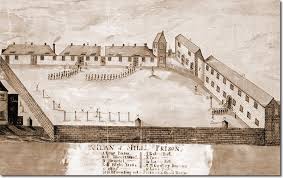
Chase was held in Mill Prison for twenty-three months, enduring terrible conditions under which several of his companions died. He again attempted to escape, hand-digging a tunnel from the prison yard, but was once again foiled. In March of 1779, Benjamin Franklin and John Paul Jones arranged for the release of 100 prisoners from Mill Prison in exchange for the release of 200 British sailors. The Mill Prison prisoners were chosen by lottery, and Thomas Chase and several Vineyard men were among them. They were put on a ship bound for Nantes, France, where Chase found a recruiting ship and enlisted as part of the Continental Navy beneath John Paul Jones on the USS Alliance. Chase was a gun captain, directing the loading, aiming, and firing of one of the ship’s canons. The Alliance played an important role in the victorious Battle of Flamborough Head in September of 1779. After being stranded in France for a time, Chase and several of the original men who signed onto the privateer with him returned to Martha’s Vineyard in 1780. The next year, Chase married Desire Luce. In 1790, he moved to Livermore with his wife and his father. Chase was a skilled woodworker, and had passed time in prison carving ladles. When he moved to Livermore, he became the town’s first cabinet maker, living well into his eighties.